Why Do Hair Transplants Fail?
Why do hair transplants fail? Learn the most common causes, from poor candidate selection to weak aftercare, and how to protect your hair transplant result.
Published
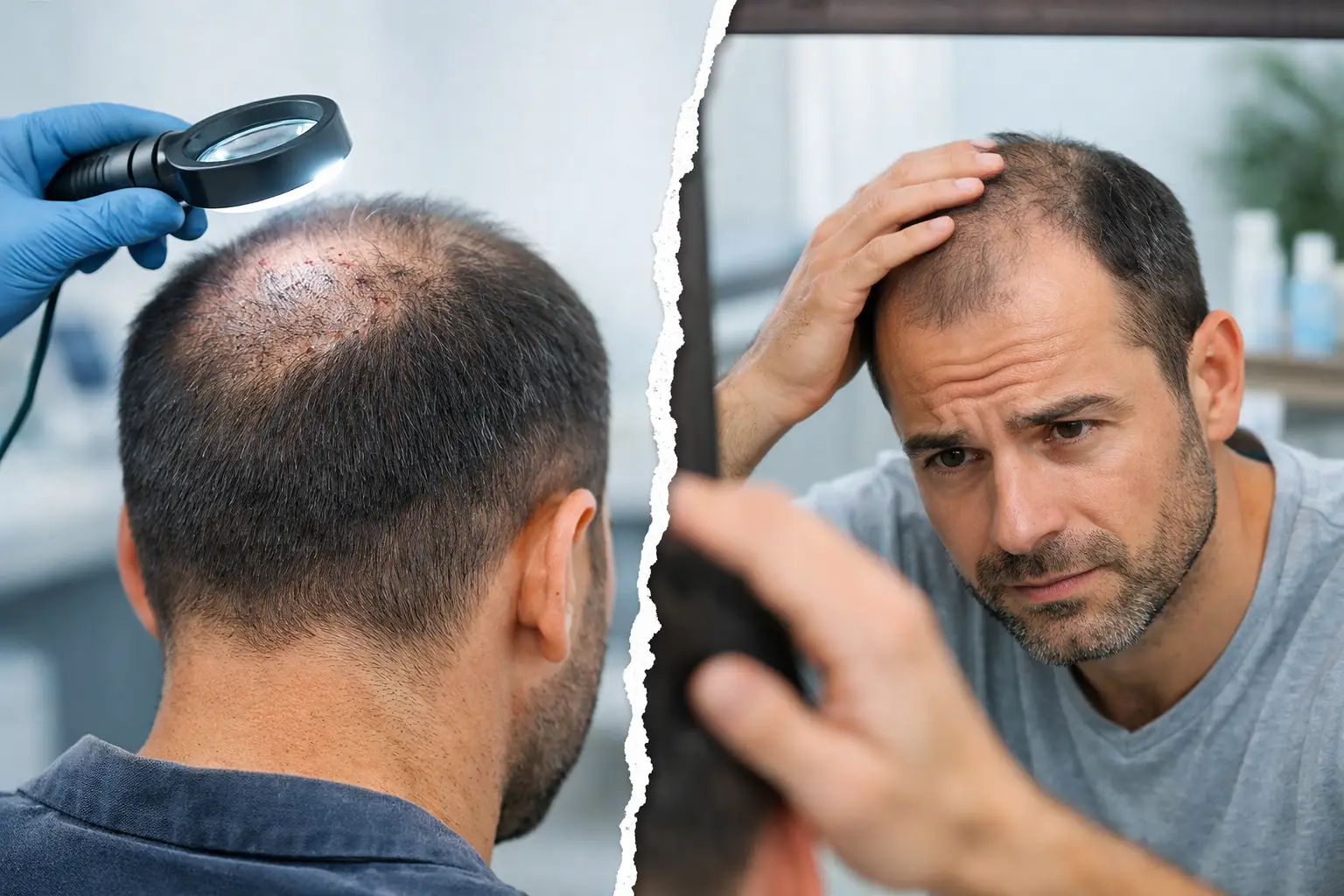
A hair transplant can look convincing on paper, yet still leave a patient with thin growth, patchy density, or a hairline that never feels right. When people ask why do hair transplants fail, they are usually not describing one dramatic event. More often, failure is the result of small decisions going wrong before, during, and after surgery.
That distinction matters. A failed result is not always caused by the body rejecting grafts or by simple bad luck. In many cases, it begins with poor candidacy assessment, unrealistic planning, rushed surgical technique, or weak aftercare. For patients considering treatment abroad, understanding those risks is part of protecting the result they are investing in. Failure is not as common as social media might suggest, but when it happens, the causes are usually identifiable and, in most cases, preventable.
🔑 Key Takeaways
- Failure is rarely one event. Most poor outcomes trace back to candidate selection, hairline design, graft handling, or aftercare rather than the body rejecting grafts.
- Donor supply sets the ceiling. A sparse or miniaturized donor zone limits achievable density, and overharvesting creates a second cosmetic problem while closing off future corrections.
- Technique decides graft survival. Excessive extraction trauma, long time outside the body, poor storage, and rough implantation all lower the number of follicles that grow.
- Aftercare is active, not passive. Scratching, smoking, heavy sweating, sun exposure, and early exercise can disturb healing during the weeks that shape the final result.
- A transplant does not stop hair loss. Transplanted grafts can survive while untreated native hair keeps thinning, so surgery needs a long-term preservation plan around it.
📊 Our Founding Team's Patient Data (2025-2026, prior to launching Wholecares)
- Overall patient satisfaction: A strong record across all treatment categories.
- International patients served: 1,200+ from 30+ countries.
- Accredited partner clinics: hold recognized international accreditations.
- Aftercare support: hair transplant patients were supported through a structured 12-month follow-up program.
- Partner surgeon experience: Board-certified specialists with extensive experience.
Why do hair transplants fail in the first place?
Hair transplantation is a medical procedure, but it is also a design procedure. Success depends on the biology of the grafts, the stability of future hair loss, the quality of the donor area, and the surgeon’s judgment in balancing immediate cosmetic improvement with long-term naturalness (ISHRS - About hair restoration). If even one of those elements is mishandled, the result can disappoint.
This is why two clinics can advertise the same procedure and produce very different outcomes. Hair grafts are not interchangeable commodities. They must be harvested gently, stored correctly, implanted at the right angle and depth, and placed according to a thoughtful plan. The process looks straightforward from the outside, but the margin for error is real.
Failure can also mean different things to different patients. For one person, failure means poor graft survival. For another, it means an unnatural hairline, visible scarring, overharvesting, or a result that looked acceptable at month six but aged poorly once native hair continued to thin. A technically completed transplant is not always a successful one.
Is poor candidate selection the biggest reason transplants fail?
Not every patient is an ideal candidate at every stage of hair loss. This is one of the most overlooked issues in the market, especially when patients are sold a package before anyone carefully studies their donor supply, family history, age, and long-term loss pattern. Comparing which technique actually fits your case is a useful test of whether a clinic is planning around you or around its schedule.
A younger patient with aggressive thinning may be eager to rebuild the front hairline immediately. But if the surgeon lowers the hairline too much or uses too many grafts early, the transplanted area may look isolated later as surrounding native hair disappears. The result can seem unnatural even if the grafts themselves survive.
Some patients also have weak donor reserves. If the donor zone is sparse, miniaturized, or already compromised, the clinic may not be able to harvest enough healthy follicles to create durable density. In these cases, the honest answer may be that expectations need to be reduced, or surgery should be delayed.
This is where a careful medical review becomes a form of protection. A trustworthy team does not simply ask how many grafts a patient wants. It asks whether surgery is appropriate, what pattern of future loss is likely, and what result can still look balanced five or ten years from now.
How does surgical technique make or break the result?
Even a well-selected patient can have a poor outcome if the procedure itself is rushed or poorly executed. Hair follicles are delicate. Excessive trauma during extraction, prolonged time outside the body, poor storage conditions, or rough implantation can lower graft survival significantly (AAD - Hair transplant).
Angle and direction matter just as much. Natural hair does not emerge in straight rows or at one universal tilt. A surgeon who lacks artistry may place grafts in a way that technically fills the area but creates a rigid, artificial appearance. Patients often notice this most at the hairline, where softness and irregularity are essential.
Density planning is another common problem. Packing grafts too aggressively can compromise blood supply in the recipient area, while spacing them too widely may leave the patient feeling they paid for coverage but not meaningful fullness. There is no single formula. The right density depends on hair caliber, curl, contrast with scalp color, and the amount of future loss expected.
Overharvesting is especially damaging because it affects not only the transplanted area but also the donor area that should remain discreet. When too many grafts are removed, the back or sides of the scalp can appear moth-eaten or visibly thinned. That creates a second cosmetic problem and can limit future corrective options. Good planning is the antidote to most transplant failures. A surgeon who explains limitations honestly is protecting you from the kind of disappointment that leads to regret.
Why does aftercare have such a strong impact on success?
Patients sometimes assume the difficult part ends when the procedure is over. In reality, the days and weeks that follow can shape the final result more than expected. This is another answer to why do hair transplants fail: the surgery may be sound, but the recovery process is not handled carefully enough.
Fresh grafts need stability. Scratching, friction, smoking, heavy sweating, sun exposure, early exercise, or sleeping in the wrong position can disturb healing. Infection is uncommon with proper hygiene, but when aftercare instructions are vague or support is limited, the risk rises. Patients who follow their aftercare instructions carefully, attend follow-up appointments, and communicate concerns early have consistently better outcomes. Aftercare is not passive. It is an active part of the result, and knowing the normal hair transplant recovery timeline makes it far easier to follow.
There is also the issue of patient anxiety. Shedding after a transplant is normal, and early growth is rarely linear. Without guided aftercare, patients may panic, resume unsafe activities too soon, or misread normal healing as failure. Strong support is not a luxury feature here. It is part of clinical protection.
For international patients, this matters even more. Once the flight home is over, questions tend to begin rather than end. That is why structured follow-up, direct access to a care team, and clear recovery protocols are not just conveniences. They are safeguards.
Which medical factors can interfere with graft survival?
Not every disappointing result comes from poor clinic standards. Sometimes the patient’s biology introduces complexity. Conditions affecting scalp health, circulation, inflammation, or autoimmune activity can reduce growth or disrupt healing.
Uncontrolled diabetes, active scalp disorders, nutritional deficiencies, and certain medications may all influence outcomes. Heavy smoking is another major factor because it can impair blood flow and slow recovery (Mayo Clinic - Hair transplant). If these risks are not identified before surgery, the transplant may be set up under less than ideal conditions.
Hormonal and genetic progression also matter. A transplant does not stop ongoing male or female pattern hair loss in untreated native hairs. This is why some patients feel the transplant failed when, in fact, transplanted grafts survived but surrounding original hair continued to thin. Without a broader hair preservation plan, the overall look can worsen over time.
The lesson is not that hair transplantation is unreliable. It is that surgery should be part of a strategy, not treated as a one-day fix.
Does the clinic model matter more than patients realize?
A significant number of disappointing outcomes begin with a process problem rather than a medical mystery. High-volume clinics may move patients through consultation, surgery, and discharge with speed that feels efficient but leaves little room for personalized planning. The sales experience can be polished while the clinical foundation is thin.
Patients should look beyond graft counts and package prices. Who designs the hairline? Who performs the extractions and incisions? How is donor management handled? What aftercare exists once the patient returns home? These are not secondary questions. They are central to the result.
For medical travelers, the quality of coordination also affects safety. Language clarity, documented treatment plans, accredited facilities, and complication support all reduce the chances of preventable mistakes. Learning how to go about choosing an accredited surgeon abroad removes much of the guesswork. A premium pathway is not about appearance alone. It is about building certainty into a process that has many moving parts.
This is one reason some patients choose a facilitated care model such as WholeCares, where provider vetting, treatment coordination, and structured aftercare are part of the journey rather than left to chance.
How can you lower the risk of a failed transplant?
The smartest protection starts before booking. A good clinic should evaluate donor capacity, hair loss pattern, medical history, and realistic density goals before discussing final numbers. If a provider promises a perfect result with no real limitations, caution is warranted.
Patients should also ask to see outcomes on cases similar to their own, not only ideal transformations. A mature patient with advanced loss needs a different plan from a younger patient seeking temple refinement. Good medicine respects those differences.
After surgery, discipline matters. Following washing instructions, protecting the scalp, avoiding nicotine, and staying in touch with the care team may sound simple, but these details can preserve thousands of grafts. The best results are rarely built on surgery alone. They come from careful planning, precise execution, and attentive recovery.
A hair transplant should feel like a carefully guided restoration, not a gamble. If you choose a team that values accreditation, realistic design, and meaningful aftercare, you give your result the strongest possible foundation. That is where confidence begins - not with promises, but with standards.
Frequently Asked Questions
Why do hair transplants fail?
Hair transplants usually fail for identifiable reasons rather than bad luck. The most common causes are poor candidate selection, a weak donor area, rushed graft extraction or placement, unrealistic hairline design, and inadequate aftercare. Medical factors such as uncontrolled diabetes, heavy smoking, and ongoing pattern hair loss in untreated native hair can also reduce growth and make an otherwise sound result look disappointing.
How common is hair transplant failure?
Complete graft failure is uncommon when an experienced surgeon operates on a suitable candidate. Most disappointing outcomes are partial rather than total: thin density, an unnatural hairline, a visibly depleted donor area, or a result that ages poorly as native hair keeps thinning. Because these causes are mostly preventable, careful planning and disciplined aftercare remove much of the risk before surgery begins.
Can a failed hair transplant be fixed?
Many failed transplants can be improved, but corrective surgery is limited by donor supply. If the donor area was overharvested, there may not be enough healthy follicles left to rebuild density. Revision work often combines hairline redesign, graft redistribution, and a long-term hair preservation plan. An honest assessment of what remains available is the first step in any correction.
Does aftercare really affect hair transplant results?
Yes. Fresh grafts need stability during the first days and weeks. Scratching, friction, smoking, heavy sweating, unprotected sun exposure, early exercise, and poor sleeping position can all disturb healing and reduce graft survival. Patients who follow washing protocols, attend follow-up appointments, and raise concerns early consistently achieve better outcomes than those who improvise their recovery.
How do I avoid a failed hair transplant abroad?
Choose a clinic that assesses your donor capacity, hair loss pattern, and medical history before quoting a graft number. Ask who designs the hairline and who performs the extractions. Confirm the facility holds recognized accreditation, request results from cases similar to yours, and check that structured aftercare and complication support continue once you return home.
Recommended Reading
This information is for informational purposes only and does not constitute medical advice. Please consult your physician.
