What Is Hair Transplant? A Permanent Solution
Discover what a hair transplant is, how the procedure works, and why it's the most effective permanent solution for hair loss. Learn about FUE and DHI methods.
Published
Key Takeaways
- Resistant by biology: Follicles taken from the DHT-resistant donor zone at the back of the head keep that resistance once relocated.
- Two leading techniques: FUE and DHI both deliver natural-looking density with minimal scarring and no linear scar.
- One-day procedure: A session runs 6 to 8 hours under local anesthesia, so you feel no pain during surgery.
- Results take time: Transplanted hair sheds early, regrows from months 3 to 4, and reaches its final look between 6 and 12 months.
- Proven outcomes: Our founding team supported 1,200+ patients treated in internationally accredited partner clinics.
What is a hair transplant?
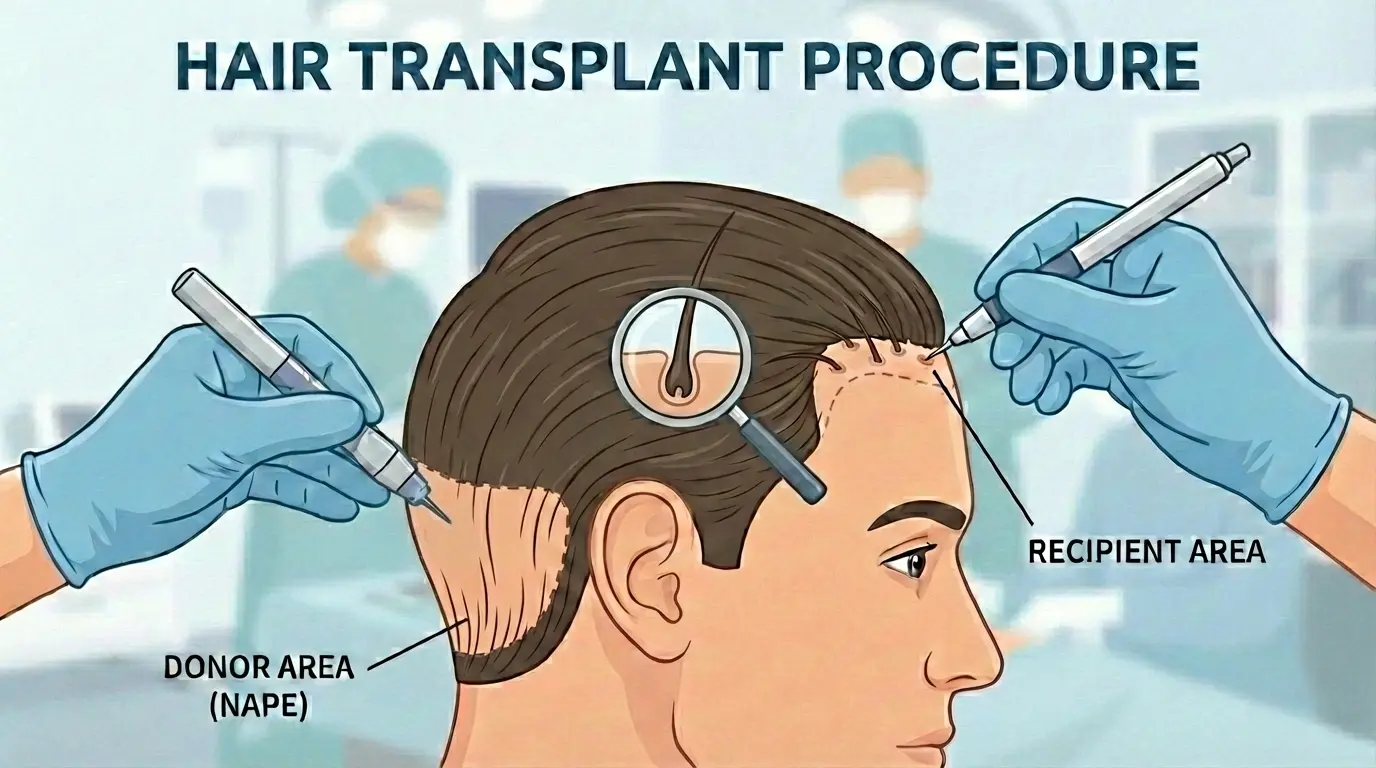
A hair transplant is a minimally invasive surgical procedure that moves healthy hair follicles from an area of dense growth to an area of thinning or baldness. The follicles are taken from the donor area, usually the back and sides of the scalp, and carefully placed into the recipient area where hair has been lost. Because the relocated follicles keep the characteristics of their original site, they continue to grow naturally in their new position.
The technique treats the most common form of hair loss, androgenetic alopecia, as well as thinning from scarring, injury, or previous surgery. Rather than masking the problem, it restores living hair that can be washed, cut, and styled exactly like the rest of your hair. To understand how it compares with non-surgical options, see our overview of hair transplant methods.
📊 Our Founding Team's Patient Data (2025-2026, prior to launching Wholecares)
- A strong record of patient satisfaction across all hair transplant procedures coordinated by our founding team.
- 1,200+ international patients served from over 30 countries worldwide.
- Internationally accredited partner clinics.
- Structured aftercare: patients were supported through a full 12-month follow-up program.
- Resistant follicles — transplanted follicles are genetically resistant to hair loss hormones.
Why are transplanted follicles resistant to hair loss?
This resistance comes down to where the follicles are harvested. Hair at the back and sides of the scalp is genetically resistant to dihydrotestosterone (DHT), the hormone responsible for pattern hair loss. When these follicles are moved to a thinning area, they carry that resistance with them and are not affected by the process that thinned the surrounding hair.
Which techniques are used: FUE and DHI?
Modern hair transplantation is dominated by two follicular unit methods. Both extract grafts one by one, so neither leaves the long linear scar associated with older strip surgery.
FUE (Follicular Unit Extraction) removes individual follicular units directly from the donor area using a micro-punch, then places them into tiny channels opened in the recipient site. It is versatile, well suited to larger sessions, and heals with only pinpoint marks that fade over time.
DHI (Direct Hair Implantation) uses a specialized implanter pen that extracts and places each graft in a single motion, giving the surgeon fine control over the angle, depth, and direction of every hair. Because channels are not opened in advance, DHI can achieve dense placement, often without shaving the recipient area. For a full side-by-side comparison, read our guide on FUE, FUT, and DHI methods.
FUE and DHI side by side
Both methods draw on the same biology and the same donor zone, so the choice is rarely about which is better in the abstract - it is about which suits your pattern of loss and the area being covered. The table below summarizes how they differ in practice.
| Consideration | FUE | DHI |
|---|---|---|
| How grafts are placed | Channels are opened first, then grafts are placed into them | Extraction and placement happen in one motion using an implanter pen |
| Shaving the recipient area | Usually shaved, though unshaven variations exist | Often possible without shaving the recipient area |
| Commonly suited to | Larger areas and higher graft counts in a single sitting | Hairlines, thinning zones, and adding density among existing hair |
| Angle and direction | Decided as the channels are opened | Decided graft by graft as each one is implanted |
The two are often combined within a single operation. What matters more than the label is the judgment behind the plan: how the hairline is designed, how sparingly the donor area is used, and how carefully each graft is handled between extraction and placement.
What happens during the procedure?
A hair transplant is performed as a day case under local anesthesia, so you stay awake and comfortable throughout. A typical session lasts 6 to 8 hours depending on the number of grafts. The surgeon first maps a natural hairline, then extracts, sorts, and implants each follicular unit. Larger cases of 3,000 to 4,000 grafts sit at the upper end of the time range. You can learn more in our walkthrough of how the procedure is performed.
Request a Free Hair Analysis
You may be eligible for a hair restoration procedure at accredited partner centers. Calculate your treatment cost and discover your personalized options.
Get a Free Hair AssessmentWhat does recovery look like?
Recovery is gradual and follows a predictable pattern. Small scabs form around each graft in the first week and fall away as the area heals. Within two to four weeks the transplanted hair sheds, which is expected and does not mean the graft has failed. New growth begins around months three to four, and the final result matures between 6 and 12 months. Our recovery timeline guide breaks the process down week by week, and our article on temporary shedding explains the shedding phase in detail.
Who is a good candidate for a hair transplant?
The best candidates have stable, well-defined hair loss and a healthy donor area with enough follicles to cover the thinning zones. Age, the pattern of loss, hair characteristics, and overall health all influence the plan and expected density. A consultation is the only reliable way to confirm suitability and set realistic goals. Our guide on candidacy for hair transplant covers who benefits most.
Suitability is not only a question of the scalp. Loss that appears suddenly, spreads diffusely, or arrives with itching, scaling, or visible inflammation may have a cause that surgery does not address. Thinning driven by thyroid disorder, illness, medication, or nutritional deficiency needs a diagnosis first, because transplanting into a scalp shedding for a treatable reason treats the symptom and misses the cause.
Why do people have a hair transplant in Turkey?
Turkey attracts a large share of international hair restoration patients for two practical reasons: accredited hospitals that perform FUE and DHI in high volume, and transparent pricing quoted up front. A hair transplant in Turkey typically costs €2,390 to €3,290, against €6,690–€31,500 in the UK and €11,300–€26,200 in the United States. Wholecares coordinates procedures with board-certified partner surgeons at accredited partner hospitals in Istanbul, and coordinated hair transplant packages bring together the surgery, hotel accommodation, airport transfers, and a dedicated health manager, with what each package covers set out in the written quote issued by the partner hospital.
Whether a hair transplant in Turkey is safe comes down to the facility and the team rather than the country on the address. The checks that matter are the same ones you would apply at home: verified accreditation, a named surgeon who carries out the critical stages personally, pre-operative screening, and a written aftercare plan. Travel adds one further question worth settling before you book - who is accountable for your follow-up once you are home. Our guide to safety red flags when choosing a clinic sets out what to look for.
What a hair transplant can and cannot do
A transplant redistributes hair; it does not create it. Every graft placed into a thinning area is taken from somewhere else on your own scalp, so the donor supply sets a ceiling on what any plan can achieve. Understanding that trade-off early is often the difference between a result you are pleased with and one that disappoints despite being technically sound.
What surgery does well is restore a frame to the face, using living hair that grows, greys, and can be cut and styled like the rest. What it does not do is switch off the genetic process that caused the loss. Native hair around the transplanted zone can carry on thinning to its own timetable, which is why surgeons raise medical treatment alongside surgery rather than as an afterthought: the operation restores what has gone, while medical therapy aims to hold on to what remains. Coverage, too, is a matter of judgment rather than arithmetic: hair calibre, curl, and how closely its color matches the scalp all shape the impression of thickness, so comparable graft counts can leave two people looking quite different.
Common misconceptions about hair transplants
Several beliefs about the procedure have outlived the techniques that produced them.
- "You can always spot a transplant." The obvious results people picture belong to the era of large punch grafts, which set tufts of hair in regular rows. Follicular unit methods move the small, naturally occurring groupings in which hair already grows, following the angle and direction of surrounding hair - which is why a well-planned result is difficult to identify.
- "The transplanted hair falls out again." It sheds in the early weeks, and that alarms anyone who was not warned. The shaft is released while the follicle beneath resets its growth cycle; the follicle itself stays where it was placed.
- "One procedure settles it for life." The transplanted grafts keep their resistance to the loss pattern, but the hair around them is not frozen in time. Some people are content after one session; others plan a smaller second session later as native loss progresses. Both are ordinary outcomes, not failures.
- "More grafts always means a better result." Density has to be balanced against a finite donor supply and against what the scalp can support in one sitting. Restraint in a first session often preserves options that an aggressive one closes off for good.
Questions worth asking at your consultation
- Which parts of the operation does the surgeon carry out personally?
- What does my donor area allow, now and for any future session?
- Where will the hairline sit, and why there rather than lower or higher?
- Is my hair loss stable, and do you recommend medical treatment alongside surgery?
- What will this look like if my native hair keeps thinning?
- What does aftercare involve, and who do I contact if something concerns me?
Our Founding Team's Track Record (Prior to Launching Wholecares)
Prior to launching Wholecares, our founding team coordinated hair restoration journeys for 1,200+ international patients from 30+ countries. FUE and DHI procedures were performed by board-certified surgeons within internationally accredited partner facilities with transparent, itemized pricing.
Considering hair transplant abroad? Wholecares can help you compare Hair Transplant packages offered by accredited hospitals in Istanbul, Turkey — with transparent pricing and a free consultation.
Explore Hair Transplant in Turkey →Frequently Asked Questions
Is a hair transplant permanent?
Yes, a hair transplant is a permanent solution. Follicles are harvested from the donor area at the back of the head, which is genetically resistant to the hormone DHT that causes pattern hair loss. Once relocated, these follicles keep that resistance and continue to grow naturally for life.
Does a hair transplant hurt?
The procedure is performed under local anesthesia, so you feel no pain during the operation itself. You may notice mild tightness or tenderness in the days afterward, but this is easily managed with the painkillers your doctor prescribes and usually settles within about a week.
How long does a hair transplant take?
A typical session takes between 6 and 8 hours, depending on how many grafts are transplanted. Larger cases of 3,000 to 4,000 grafts sit at the upper end of that range. The work is usually completed in a single day, and most patients travel home within two to three days.
When will I see the final results of a hair transplant?
Transplanted hair sheds within the first few weeks, which is normal. New growth begins around months three to four, and most patients see the full, final result between 6 and 12 months after surgery as the hair thickens and matures into its natural pattern.
What is the difference between FUE and DHI hair transplants?
FUE extracts individual follicular units and places them into pre-opened channels, while DHI uses an implanter pen to extract and place grafts in one step. DHI allows dense placement without shaving the recipient area, whereas FUE is versatile for larger sessions. Both leave minimal scarring.
Why do people get a hair transplant in Turkey?
Turkey has become a leading destination for hair restoration because accredited hospitals there perform FUE and DHI in high volume and quote all-inclusive pricing up front. A hair transplant in Turkey typically costs €2,390 to €3,290, against €6,690–€31,500 in the UK and €11,300–€26,200 in the United States. Wholecares coordinates procedures at accredited partner hospitals in Istanbul, bringing together the surgery, hotel accommodation, airport transfers, and a dedicated health manager.
Is a hair transplant in Turkey safe?
Safety depends on the facility and the surgical team rather than the country. An accredited hospital, a named board-certified surgeon who carries out the critical stages personally, pre-operative medical screening, and a documented aftercare plan are what make any procedure safe. Verify accreditation in writing before you book, and confirm who manages your follow-up once you are home.
How do I choose a hair transplant clinic in Turkey?
Ask which parts of the operation the surgeon performs personally, what your donor area realistically allows, and exactly what the quoted price includes and excludes. Treat unlimited-graft promises, unnamed surgeons, and pressure to book quickly as warning signs. Compare written all-inclusive quotes rather than advertised headline prices.
Recommended Reading
This information is for informational purposes only and does not constitute medical advice. Please consult your physician.
